If you’ve ever worked in event production—whether you’re setting up a concert for 50,000 people, a corporate awards show, or a small-scale theater production—you know stage trusses are far more than just metal frameworks to hang lights, speakers, or backdrops. They’re the backbone of every safe, seamless event, and as a stage truss supplier with 12 years on the job, I’ve seen firsthand how one often overlooked factor can derail even the most well-planned setup: temperature changes. Stage Truss
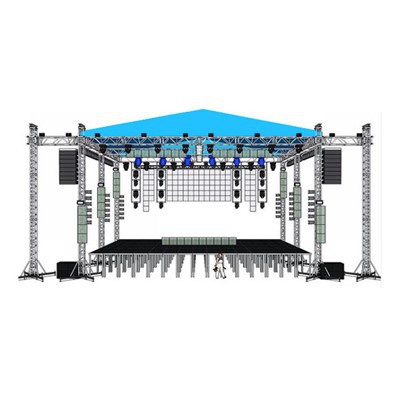
For most crews, adjusting trusses for temperature doesn’t make it into their pre-event checklists. They focus on load ratings, bolt torque, and assembly timelines—but every metal truss expands when it heats up and contracts when it cools down, and the scale of that movement is easy to miss… until something goes wrong. Last year, a regional festival client brought their trusses to our warehouse for testing before their main stage setup. Normally, we’d approve their aluminum ground-support trusses right away, but that day we noticed a small gap between two bolted sections. We checked the temperature difference: the warehouse was 68°F, the client planned to set up the stage at 92°F, and the event would peak at 101°F the next day. That gap was just enough to cause the bolts to shear mid-show, or worse, the truss to twist under load. We walked them through the adjustment, saved them from a disaster, and that experience drove home how critical this topic is.
Let’s break down the science first, because it’s not just vague “metal expands”—it’s predictable, measurable, and depends entirely on the type of truss material you use. Most stage trusses are made of either aluminum (the go-to for lightweight, mobile setups) or steel (stronger, for heavy loads like large sound systems or giant video screens). Each material has a different coefficient of thermal expansion, a number that tells you how much a unit of length changes per degree of temperature shift. Aluminum expands at a rate of about 0.0000128 inches per inch of length, per degree Fahrenheit; steel comes in a bit lower, at around 0.0000065 inches per inch, per degree. So a 40-foot aluminum truss, exposed to a 30°F temperature swing—super common between early morning setup and midday event time—will expand by 0.614 inches. That’s almost two-thirds of an inch of movement you can’t ignore.
Now, what does that mean in real-world terms? For a truss that’s bolted tightly at both ends (a fixed connection), thermal expansion creates thermal stress. If that stress exceeds the truss’s tensile strength, it can bend, buckle, or even break. Aluminum, while lighter, is more prone to this kind of failure because its lower tensile strength paired with higher expansion rates make it less forgiving. For steel trusses, the stress is lower, but it’s still enough to pull bolts out of alignment if the connection points aren’t accounted for. The bigger the truss, the bigger the issue: a 100-foot truss will expand twice as much as a 50-foot one, so a large main stage truss can easily move an inch or more over a single day’s temperature shift.
It’s not just linear movement, either. Temperature changes can also cause warping, especially for long, thin trusses that are mounted horizontally. On a hot day, the top of a truss (which faces direct sunlight) gets hotter than the bottom (which rests on the ground or is shaded), creating a temperature gradient. That uneven heating makes one side expand more than the other, warping the truss into a slight arch. We’ve seen this with steel trusses that were set up with tight end bolts: the warping pulled the bolts so tight that by midday, the truss had a permanent bend, and the client had to replace it mid-event. For aluminum, warping is even more common because it softens at higher temperatures, making it more flexible and likely to hold that bent shape after cooling.
Another, less obvious impact is on truss connections. Most stage trusses use bolted splices, pin connections, or clamp-style joints. When trusses expand or contract, these connections have to handle that movement without loosening or failing. For aluminum trusses, which expand much more, pin connections—designed to allow slight horizontal movement—are usually safer than fixed bolted connections, because they let the truss shift without stress. But if a crew uses a fixed bolt on an aluminum truss that’s going to see large temperature swings, the bolts can stretch or snap. Last year, a small theater group didn’t account for a 25°F temperature change between their evening rehearsal and the opening night show. Their steel trusses were bolted tightly, and the aluminum extension trusses bolted to them expanded just enough to strip the bolt threads, causing a speaker panel to slip 18 inches from its mount. No one got hurt, but they had to delay the show for two hours while we swapped out the damaged truss sections. That’s not a huge incident, but it’s a reminder that even small temperature shifts can create big problems if connections aren’t designed for movement.
What about indoor events? You might think temperature changes don’t matter in a climate-controlled venue, but that’s not always true. The lighting and heating systems can create uneven temperatures across a stage area. For example, a venue might keep the main floor at 70°F, but the area above the stage where trusses hang could be 75°F because of stage lights and ventilation vents. That small difference might seem trivial, but over a 60-foot truss, that’s still a 0.038-inch expansion for aluminum, enough to put stress on mounting brackets. Even more, some events have temporary setups that bring outdoor trusses into a space, so a truss that was sitting in 40°F weather will warm up when it’s hung in a 72°F venue, expanding by almost a quarter of an inch before the show even starts. We’ve had clients miss this and end up with loose mounting brackets, because they didn’t account for the temperature shift between truss storage and indoor setup.
So what can you do to mitigate these issues? As a truss supplier, we work closely with our clients to build temperature resilience into every setup, no matter the size. First, know your material. If you’re working with aluminum for a large outdoor truss setup, adjust your connection points to allow for movement. Use pin and clevis joints instead of fixed bolts, or add a slight gap between truss sections at setup temperature to accommodate expansion. For steel trusses, which handle lower expansion rates better, you can usually use fixed bolts, but always torque them to the manufacturer’s specifications—not tighter. Over-tightening bolts is a common mistake that adds unnecessary stress, especially when temperature changes hit.
Second, measure temperature swings ahead of time. We recommend using a temperature map of the venue or event space, including peak day temperatures for outdoor events and indoor temperature differentials, to calculate expected expansion. For a 100-foot aluminum truss, a 30°F swing means 0.96 inches of movement—so add that into your layout when placing end anchors. If the truss is mounted to the ceiling, use adjustable ceiling brackets that can shift slightly instead of rigid, fixed mounts.
Third, do a pre-event stress test. For any setup with trusses longer than 40 feet or that will see temperature swings of 20°F or more, ask your supplier to help you run a quick load test that simulates temperature expansion. We bring portable temperature chambers to client sites for small jobs, or run calculations for larger setups to confirm that trusses and connections can handle thermal stress. Last spring, a client was setting up a main stage for a country music festival in Arizona, where daytime temperatures hit 105°F and nighttime dropped to 50°F. We calculated a 1.28-inch expansion on their 100-foot aluminum trusses, adjusted their end anchors to allow that movement, and added a small shim to absorb any excess force. They had zero issues during the three-day festival, which is a huge win for us and for their team.
It’s also important to note that temperature changes can accelerate wear and tear on trusses over time. Repeated expansion and contraction cycles cause fatigue in metal, especially at connection points where stress is concentrated. That’s why regular inspection of trusses is non-negotiable—after every event, check for bent sections, stripped bolts, or worn pins that could be weakened by thermal stress. We offer a truss inspection service for our clients, where we test for material fatigue and replace worn sections before they become a safety hazard.
If you’re reading this and thinking, “I’ve never had a problem with temperature and trusses,” that’s great—but it’s also a matter of luck. Every year, we get a handful of emergency calls from clients who ignored temperature adjustments and ended up with damaged trusses, delayed shows, or even safety issues. Last summer, a client in Texas set up their main stage trusses in 80°F weather, not realizing the temperature would hit 102°F by showtime. Their fixed bolt connections on the 80-foot aluminum trusses couldn’t handle the 0.51-inch expansion, so a section of truss bent under the weight of two large speaker stacks. No one was hurt, but they had to evacuate the crowd for 90 minutes while we brought replacement trusses to the site. That cost them thousands of dollars in lost ticket revenue and vendor fees, all because they overlooked a factor that’s easy to plan for.
As a stage truss supplier, our job isn’t just to sell trusses—it’s to help clients build safe, reliable setups that can handle every variable, including temperature. We don’t just give clients a list of load ratings; we walk them through how to adjust for their event’s specific temperature conditions, help with layout designs that account for thermal movement, and offer support on-site during setup to catch small issues before they become big problems.

If you’re planning an event, large or small, and you want to make sure your trusses are safe and ready for whatever temperature shifts might come, don’t leave anything to chance. Reach out to our team to discuss your event needs, get a custom truss design, and learn how we can help you avoid thermal stress issues. Whether you’re setting up a 10-foot truss for a local theater or a 200-foot main stage for a national tour, we’ve got the expertise to make your setup safe and seamless.
Aluminum Pallet References
- American Institute of Steel Construction. (2021). Thermal Stress in Structural Steel Members. AISC Design Guide 25.
- Aluminum Association. (2019). Thermal Expansion Properties of Structural Aluminum Alloys. Aluminum Design Manual.
- Occupational Safety and Health Administration (OSHA). (2020). Safe Use of Steel and Aluminum Trusses in Event Production. OSHA Technical Manual, Section IV, Chapter 2.
- Event Safety Alliance. (2022). Thermal Stress Mitigation for Temporary Stage Structures. Event Safety Guide, 5th Edition.
Jiangsu Shizhan Group Co., Ltd.
Jiangsu Shizhan Group Co., Ltd. is one of the most professional stage truss manufacturers and suppliers in China, specialized in providing high quality products and service. We warmly welcome you to buy custom made stage truss at competitive price from our factory. Contact us for more details.
Address: 80# Xixin Road, Xibei Town, Xishan District, Wuxi, Jiangsu, China
E-mail: jsshizhan@shizgroup.com
WebSite: https://www.leadertrusses.com/
