If you’ve ever stood in a factory maintenance bay, watching a line worker swap out a worn drive belt, or pulled a rusty lawnmower cord to start a weekend yard project, you’ve relied on wrapped V belts without even realizing it. For over a century, these belts have been the unsung workhorses of power transmission: they wrap around grooved pulleys, transfer torque between shafts, and keep everything from conveyor systems to agricultural equipment running smoothly. As someone who’s spent the last 12 years as a wrapped V belt supplier—helping factories, farm operations, and small shop owners pick belts that last, not just fit—I’ve seen firsthand how one tiny, often overlooked detail can make or break a belt’s performance: pulley diameter. Wrapped V Belt
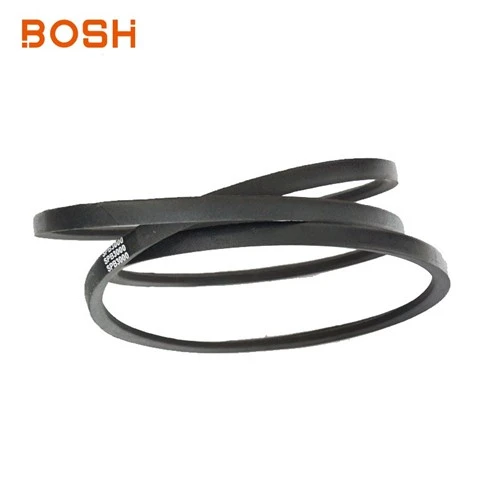
Most people think of a V belt as just a loop of rubber and fabric, but the pulley it wraps around is where the magic (and the stress) starts. When a belt is mounted on pulleys, the tension that drives power isn’t just from being pulled tight between two wheels—it’s distributed unevenly across the contact surface, and that uneven distribution gets way worse when pulley sizes change. Let’s start with the basics: a wrapped V belt works on friction, right? The “V” shape of the belt sits into the matching groove of the pulley, creating more surface area contact than a flat belt could, which means more grip and less slippage. But that grip isn’t automatic. It depends on how much of the belt’s length is actually in contact with the pulley, and that contact arc is directly tied to pulley diameter.
If you mount the same wrapped V belt on two pulleys—one large, one small—the small pulley will have a shorter contact arc. Think of wrapping a string around a pencil (small diameter) versus a soda can (large diameter). The pencil only lets the string curve around about 180 degrees, while the soda can lets it wrap almost 270. For a V belt, that smaller contact arc on a small pulley means less friction to hold the belt in place under load. If you’re driving a heavy load, like a grain auger or a conveyor full of packed boxes, slippage becomes a real risk. That’s not just annoying—it’s costly. A slipping belt wastes energy (the motor is working harder to turn a belt that’s not gripping), wears out faster, and can shut down an entire production line mid-shift. Last year, I got a frantic call from a small grain cooperative in Iowa. They’d replaced their old belts with a cheaper, off-brand wrapped V belt, and their small head pulley (8 inches in diameter) was causing constant slippage during harvest. We swapped them for a belt matched to their pulley size, and they didn’t have a single slip incident for the rest of the season. That’s the power of getting that pulley diameter right.
But slippage is just the start of the story. The real damage happens under the belt’s surface, in the tension and flexing that comes from bending a belt around a small pulley. Every time a wrapped V belt wraps around a pulley, it has to bend to fit the pulley’s curve. The smaller the pulley, the sharper that bend. Wrapped V belts are built with multiple layers: a tough rubber core, fabric wraps for abrasion resistance, and tensile cords (usually polyester or aramid) that carry most of the power load. When you bend that belt tightly around a small pulley, those tensile cords and the rubber matrix around them get crushed and stretched unevenly. The outer side of the belt (the part facing away from the pulley) stretches, while the inner side compresses. With each rotation, that stretch-compress cycle wears on the belt’s internal structure.
I’ve tested this countless times in the shop. We took three identical wrapped V belts, mounted each on pulleys of different diameters: 4 inches, 8 inches, and 16 inches. We ran them at the same load and speed for 100 hours, then inspected them. The belt on the 4-inch pulley showed visible cracking on the outer wrap, frayed tensile cords, and a 15% stretch in length. The belt on the 8-inch pulley had minor surface wear but no internal damage. The belt on the 16-inch pulley was virtually untouched. That 4-inch pulley didn’t just cause slippage—it cut the belt’s lifespan by two-thirds. Why? Because of flex fatigue. Tensile cords can only bend so many times before they break. A small pulley’s sharp bend means more bending per rotation, adding up to thousands of extra bends over the life of the belt. For industrial belts that run 24/7, that adds up to months of lost production if the pulley is too small.
There’s also a less talked-about factor: heat. When a belt slips on a small pulley, or bends sharply enough, friction generates extra heat. Wrapped V belts are designed to dissipate heat, but that only works up to a point. Too much heat breaks down the rubber, melts the fabric wrap, and weakens the tensile cords. We once had a client in the construction industry who used a wrapped V belt on a small pulley for their cement mixer. They were replacing belts every two weeks, which was eating into their profit margins. When we ran thermal tests on their setup, we found the belt was operating at 180 degrees Fahrenheit, 30 degrees over the manufacturer’s recommended limit. Switching to a belt sized for a larger pulley dropped the operating temperature to 145 degrees, and their belt lifespan jumped to three months. That’s a huge difference, and it all traced back to pulley diameter.
Now, some people might think: “Why not just use a stronger belt to compensate for a small pulley?” But here’s the thing: belt strength and pulley diameter aren’t independent variables. The American Society of Mechanical Engineers (ASME) has published guidelines for V belt power transmission that explicitly state the minimum pulley diameter required for a given belt type. For example, a standard A-section wrapped V belt has a recommended minimum pulley diameter of 3 inches. If you put that same A-section belt on a 2-inch pulley, you’re violating that guideline, and you’ll see the flex fatigue and heat issues we talked about. B-section belts jump to a 5-inch minimum, and C-section to 9 inches. This isn’t arbitrary—it’s based on decades of real-world testing and field data. I’ve seen clients try to “upgrade” to a higher-rated belt for a small pulley, only to find the same wear and tear because the diameter was still too small. The belt’s strength can only do so much; it can’t undo the stress of bending around a pulley that’s too tight.
There’s another edge case that’s worth mentioning: when you have two pulleys of different sizes, like a motor pulley and a drive pulley. The smaller of the two is always the one that causes the most stress. Even if the larger pulley is well-sized, if the motor pulley is too small, you’ll still get slippage and flex fatigue. That’s a common mistake in custom setups. A lot of system designers focus on getting the right speed ratio between pulleys, but they forget to check the minimum diameter for the smaller pulley. Last year, we worked with a packaging company that was building a new conveyor system. They’d set their motor pulley to 2.5 inches to get the exact speed they wanted for their bottles, but that was half the recommended minimum for their chosen B-section wrapped V belt. We adjusted the motor pulley to 5 inches, paired it with a larger drive pulley, and they got their exact speed, plus a 40% longer belt life. It was a win-win.
As a wrapped V belt supplier, my job isn’t just to sell belts—it’s to help customers avoid these common pitfalls. I’ve seen so many businesses waste money on premature belt replacements, unplanned downtime, and higher energy bills because they underestimated how much pulley diameter matters. The good news is that fixing this issue is almost always simple. You don’t have to buy a whole new belt system, just match the belt to the pulley diameter, and make sure the smaller pulley in your setup meets the industry’s minimum guidelines. If you’re unsure what size pulley you need, or which belt works best with your existing pulleys, all you have to do is reach out.
I’ve been in this industry long enough to know that the smallest details make the biggest difference. A pulley diameter that’s a few inches too small might seem insignificant on paper, but in practice, it can turn a reliable workhorse into a constant headache. The belts that keep your business running deserve to be paired with the right components, and the right pulley diameter is non-negotiable.
Next time you’re troubleshooting belt wear or looking to upgrade your power transmission setup, don’t overlook that pulley. It’s not just a wheel to wrap the belt around—it’s the foundation of how your belt performs, how long it lasts, and how much it costs you in the long run. If you’ve got questions about pulley diameter, wrapped V belts, or how to get the most out of your power transmission system, I’m here to help. We can walk through your setup, recommend the right belt and pulley specs, and make sure your equipment runs smoothly for years to come.
Oil Seal References
ASME B106.1M-1985, Performance Standards for V-Belts and Sheaves for Horsepower Ratings
Machine Design, 2021, “Understanding V-Belt Pulley Diameter Effects on Belt Life and Performance”
Rubber Manufacturers Association, 2020, “Wrapped V Belt Design and Application Guidelines”
Xingtai Boshuo Auto Technology Co., Ltd.
Xingtai Boshuo Auto Technology Co., Ltd. is one of the most professional wrapped v belt manufacturers and suppliers in China, featured by quality products and low price. Please rest assured to wholesale bulk customized wrapped v belt made in China here from our factory. Welcome to contact us for pricelist and free sample.
Address: No. 58 Quannan East Street, Xiangdu District, Xingtai City, Hebei Province
E-mail: sherry1@bs-belt.com
WebSite: https://www.bsbelts.com/
